Key facts
Key facts
12m golden Buddha
Built 1972
Free admission (donations welcome)
About 7 AM-6:30 PM
73-step naga staircase
Koh Faan island via causeway
5 min from airport
Shoulders and knees covered
Wat
Theravada | No. 5 of 30
12m golden Buddha
Built 1972
Free admission (donations welcome)
About 7 AM-6:30 PM
73-step naga staircase
Koh Faan island via causeway
5 min from airport
Shoulders and knees covered
Compass
Bearings from here
| Place | Bearing | Distance |
|---|---|---|
| Guam Im Shrine | 64° | 0.6 km |
| Wat Plai Laem, Koh Samui | 85° | 0.7 km |
| Wat Bo Phuttharam | 241° | 3.5 km |
| Samui International Meditation Center | 235° | 3.5 km |
| Pagoda Khao Hua Jook | 183° | 3.8 km |
| Wat Sawang Arom | 201° | 4.7 km |
| Maenam Chinese Temple | 269° | 6.8 km |
| Wat Phu Khao Thong Koh Samui | 265° | 7.1 km |
| Wat Na Phra Lan | 279° | 8.4 km |
| Wat Teepangkorn, Koh Samui | 218° | 9.8 km |
| Wat Lamai | 190° | 10.9 km |
| Secret Buddha Garden Koh Samui | 217° | 12.1 km |
| Wat Namtok Hin Lad | 244° | 12.7 km |
| Dipabhavan Meditation Center | 197° | 12.9 km |
| Wat Sila Ngu | 193° | 13.6 km |
| Nathon Hainan Shrine | 253° | 14.1 km |
| Wat Chaeng Nathon | 251° | 14.3 km |
| Guan Yu Koh Samui | 196° | 14.5 km |
| Wat Khunaram | 206° | 15 km |
| Wat Samret Koh Samui | 200° | 15.6 km |
| Wat Pradoem | 208° | 15.9 km |
| Wat Nara Charoen Suk | 238° | 16.1 km |
| Buddha Footprint Koh Samui | 202° | 16.7 km |
| Monk Cave Koh Samui | 199° | 17.4 km |
| Wat Kiri Wongkaram | 227° | 18.7 km |
| Laem Sor Pagoda | 210° | 20.3 km |
| Wat Laem Sor | 210° | 20.5 km |
| Wat Khao Chedi | 210° | 20.6 km |
| Wat Khiri Mat | 219° | 20.9 km |
On site
Reading the grounds
The figures, symbols and buildings recorded at this temple, grouped by what they are rather than where they stand, linked back to the glossary wherever a card already explains them.
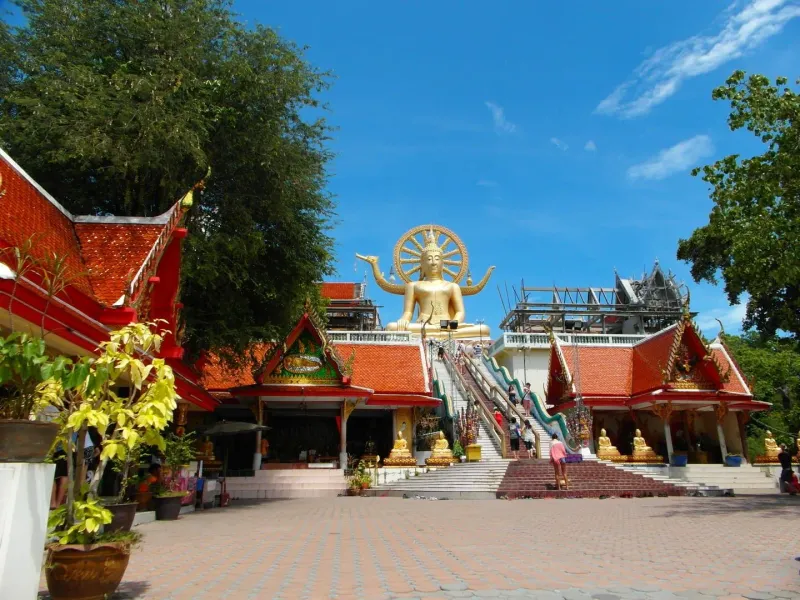
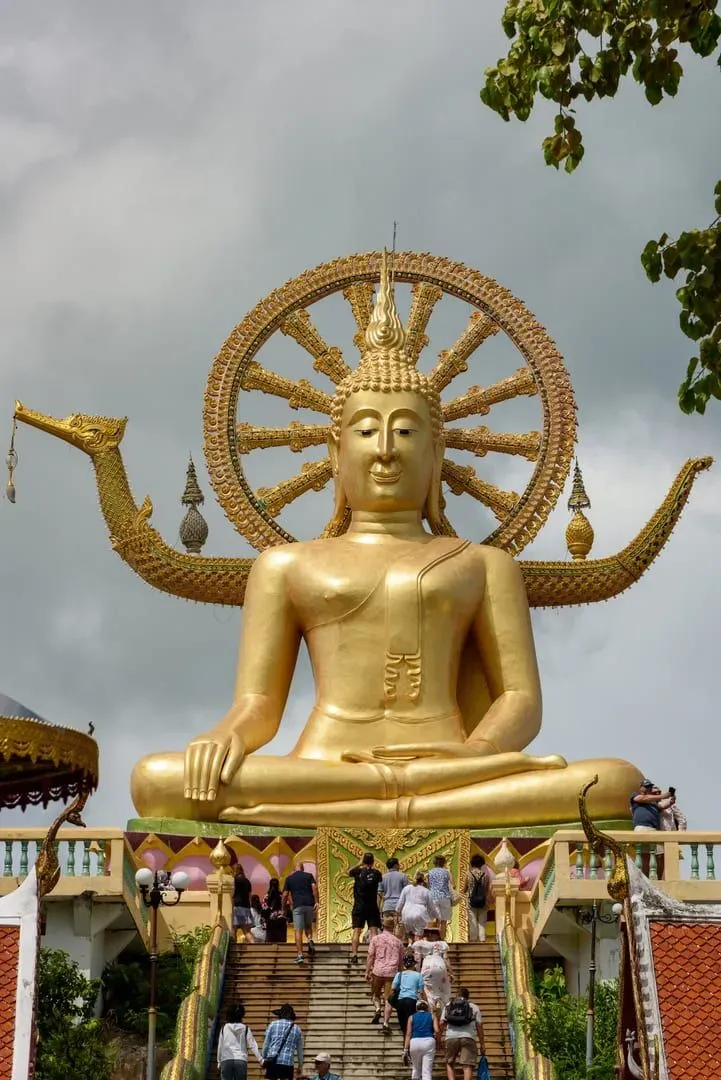
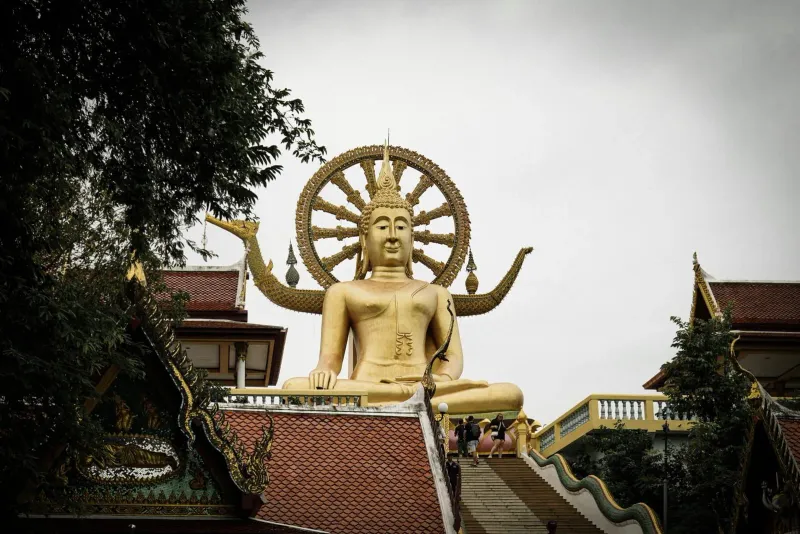
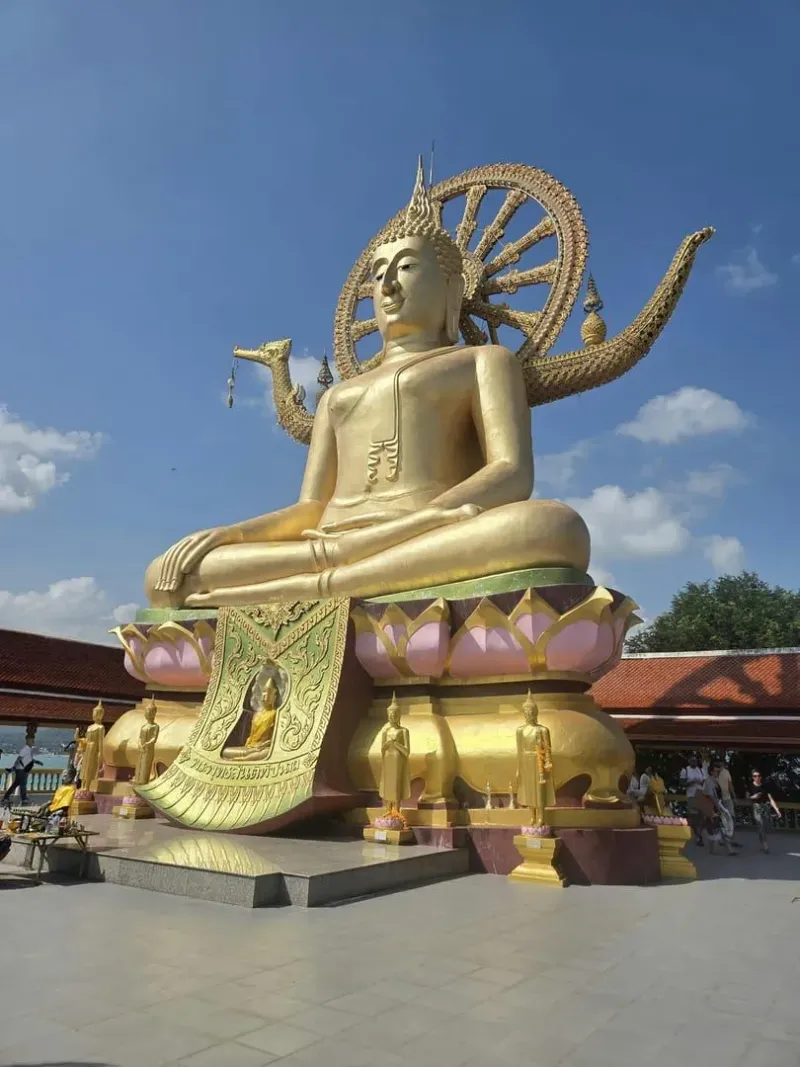
Wat Phra Yai on Koh Samui, known as the Big Buddha Temple, is free to enter and open daily from about 7:00 AM to 6:30 PM (sources give 6:00-18:30). A 12-meter golden Buddha sits on Koh Faan, a small rocky island linked to the northeast coast by a causeway, and you reach it by a 73-step naga staircase. Visible from incoming flights to Samui Airport (just 5 minutes away), it’s often the first thing visitors see of the island.
Built in 1972 and funded by community donations, the temple is still an active place of Buddhist worship as well as Samui’s most-visited cultural attraction. The statue shows the Buddha in the Bhumisparsha Mudra (earth-touching gesture), gazing east over the Gulf of Thailand toward Koh Phangan.
There is no ticket and no entrance fee at Wat Phra Yai: walk in, climb the stairs and leave a donation if you like (50-100 THB, about 1.50-3 USD, is typical). The grounds are open daily from dawn to dusk, about 7:00 AM to 6:30 PM on most listings (some say 6:00 AM), so confirm locally on a holiday. Sarong rental at the entrance and market purchases are the only costs.
“Tickets” you may see online are for guided half-day tours that include Big Buddha, typically 800-1,500 THB per person with hotel pickup (as of 2026); the temple itself never charges. Going alone by scooter or taxi is simple, see Getting There below.
Wat Phra Yai was built in 1972 through a community effort. Local monks led the project, funded by donations from Samui’s residents and visitors, as an act of merit-making (tham bun), one of the central ideas in Theravada Buddhism.
Wikipedia has a short entry on Wat Phra Yai. Since then the Big Buddha has become inseparable from the island’s identity: for locals a symbol of faith, for visitors the definitive Samui landmark, featured on postcards and travel guides for over five decades.
The seated Buddha stands 12 meters (about 39 feet) tall on a concrete structure with a gold-coloured finish that gleams from the sea, the air and much of the northeast coast.
At 12 meters it is modest next to Thailand’s giants, such as Phuket’s Big Buddha (about 45 meters) or the Great Buddha at Wat Muang in Ang Thong (about 92 meters, the tallest in the country). What sets Samui’s apart is the setting: an island hilltop beside the sea with the airport at its foot, and an active temple rather than a monument alone.
The statue depicts the Mara Vijaya (Victory over Mara):
The gesture represents the moment the Buddha, having overcome the temptations sent by Mara (the Lord of Illusion), called on the Earth to witness his enlightenment. It stands for unwavering determination.
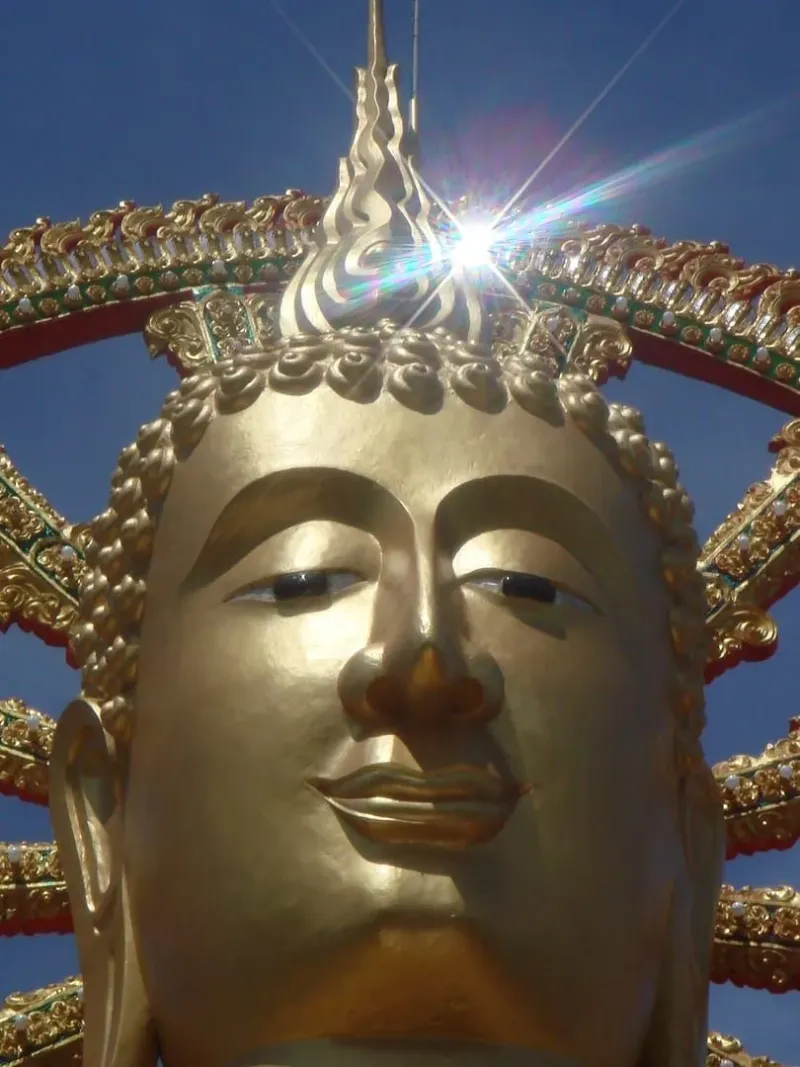
The Buddha gazes eastward over the Gulf of Thailand, and on clear days Koh Phangan is visible across the strait. Because it faces east, morning sunlight lights the golden face directly: the best time for photographs.
The temple sits on Koh Faan (also spelled Ko Phan), a small rocky island just offshore from the northeast coast near Bang Rak Beach. A short paved causeway connects it to the main road, so you can arrive by car, scooter or on foot.
The causeway is lined with market stalls and vendors selling everything from Buddha amulets to coconut drinks (see The Causeway Market below).
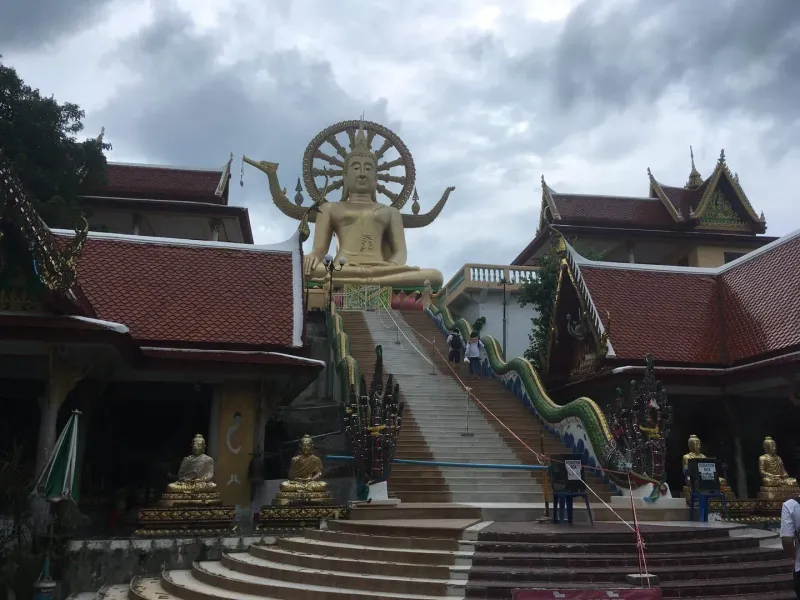
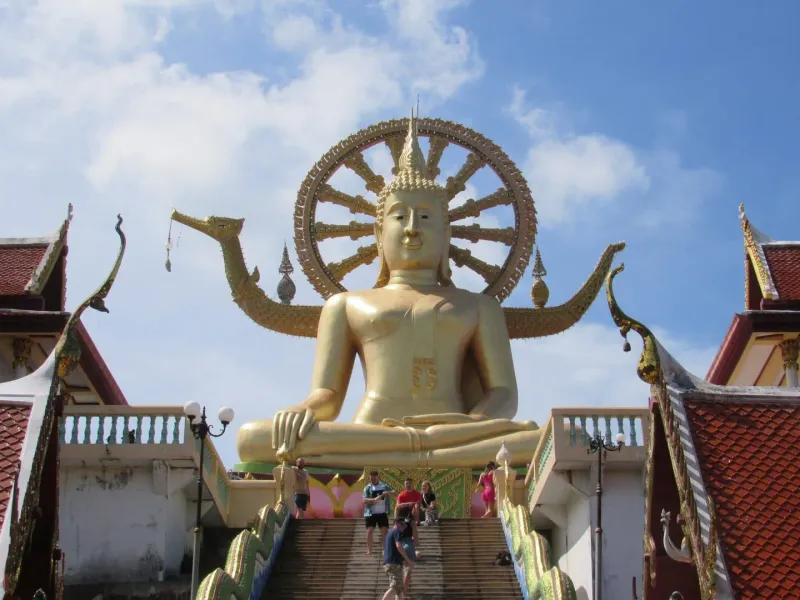
The approach is a grand staircase of 73 steps flanked by ornate Naga serpent figures, mythical guardians from Buddhist and Hindu tradition whose scaled bodies run up both sides of the hill.
The staircase is wide and well-maintained but steep, and there is no elevator or alternative route: the 73 steps are the only way up, about 5-10 minutes at a comfortable pace.
Photography tip: shoot from the bottom looking up, with the golden Buddha framed between the nagas at the top.
The statue is the main event, but the complex has more to offer.
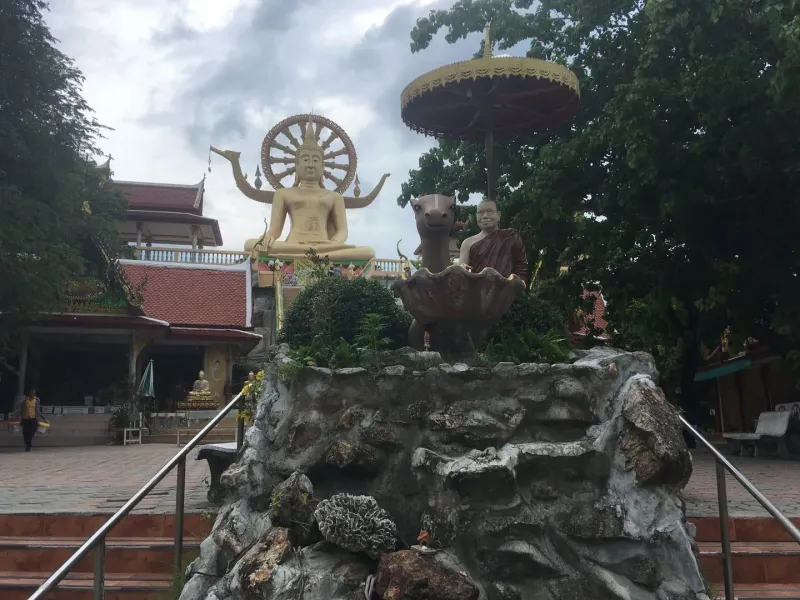
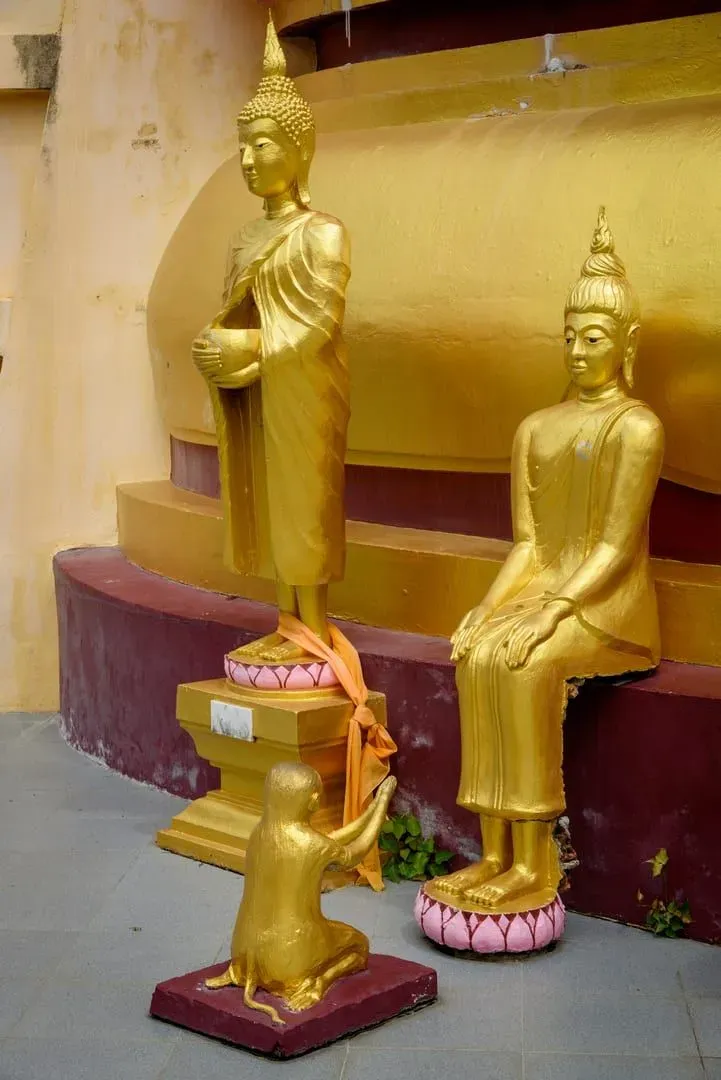
A ring of smaller shrines and Buddha images in different postures surrounds the base of the statue. They are quieter spots away from the main viewing area.
At the rear, a row of large bells and gongs invites visitors to strike them with a wooden stick for a small donation, an act of merit-making. The deep sound carries across the water.
Visitors can offer fruit, flowers or incense at several points. Donation boxes are placed throughout; 50-100 THB is appreciated and goes toward temple upkeep.
From the top, the platform gives 360-degree views: the Gulf of Thailand to the east, Koh Phangan in the distance, the Samui coastline to the south, and the airport runway below, where you can watch planes land and take off.
The causeway is lined with stalls selling:
The market is busiest from about 10 AM to 4 PM. Prices are tourist-oriented but reasonable by Samui standards.
Cover your shoulders and knees: no tank tops, short shorts or beachwear. Wat Phra Yai is an active place of worship, and staff can turn away visitors who are not properly dressed. Sarongs can be rented at the entrance for a small fee, or bought at the causeway market. See also our temple etiquette guide.
Big Buddha (30-60 min), then Wat Plai Laem (30-45 min), then lunch at Fisherman’s Village in Bophut, followed by Choeng Mon or Bang Rak Beach.
Northeast coast, in the Bang Rak / Big Buddha area. The causeway turnoff is well signed from Route 4171. Free parking at the base.
| Starting Point | Drive Time | Taxi Cost |
|---|---|---|
| Airport | 5 min | 150-250 THB |
| Bophut | 5-10 min | 150-300 THB |
| Chaweng | 15 min | 250-500 THB |
| Choeng Mon | 10 min | 200-350 THB |
| Lamai | 30-40 min | 400-600 THB |
| Nathon | 40-50 min | 600-800 THB |
The best time for Big Buddha is before 9 AM: the east-facing statue is lit by the first light, it is cool and the tour groups have not arrived. Late afternoon (4-5:30 PM) brings warm light and thinner crowds. The front of the statue is in shade by sunset, so sunset is better for views from the platform than for face shots; for Wat Phra Yai photos the naga staircase from below is the classic frame.
| Time | Conditions | Rating |
|---|---|---|
| Sunrise (6-7 AM) | East-facing statue lit by first light. Very few visitors (gates may open slightly later, so confirm). | ★★★★★ |
| Early morning (7-9 AM) | Peaceful, cool, soft light. Best for photography. | ★★★★★ |
| Mid-morning (9-11 AM) | Tour groups begin arriving. Still pleasant. | ★★★★ |
| Midday (11 AM-2 PM) | Avoid: the exposed staircase is very hot. Peak crowds. | ★★ |
| Late afternoon (4-5:30 PM) | Warm light, cooling temperatures, thinning crowds. | ★★★★ |
The 73-step staircase is the only way to reach the statue, with no elevator or ramp, so it is not suitable for wheelchairs or visitors with significant mobility limitations. The market area and causeway are flat.
| Traveler Type | Fit | Why |
|---|---|---|
| First-time visitors | ★★★★★ | The iconic Samui landmark |
| Photographers | ★★★★★ | Golden statue, naga staircase, panoramic views |
| Families | ★★★★ | Free, short visit, market keeps kids engaged |
| Spiritual seekers | ★★★★ | Active temple with merit-making |
| Budget travelers | ★★★★★ | Free admission, cheap songthaew access |
| Couples | ★★★★ | Sunrise visits; pair with Wat Plai Laem |
| Mobility limited | ★★ | 73 steep steps with no alternative access |
Yes. Wat Phra Yai has no entrance fee and sells no tickets. Donations of 50-100 THB are welcome and go toward upkeep. The only costs are optional: sarong rental at the entrance and purchases at the causeway market stalls.
The grounds are open daily from about 7:00 AM to 6:30 PM, though some listings say 6:00 AM, so confirm locally. For the best light visit at sunrise to 9 AM, when the east-facing statue is lit and the tour groups have not yet arrived.
73 steps up the naga staircase. It is wide and well maintained but steep, with no elevator or alternative access. Allow 5-10 minutes to climb at a comfortable pace, and bring water outside the cool months.
Cover your shoulders and knees: no tank tops, short shorts or beachwear. If you arrive underdressed, sarongs can be rented at the entrance for a small fee. Remove shoes before entering temple buildings.
About 15 minutes by car or scooter. By taxi expect 250-500 THB, by songthaew 50-100 THB per person. The temple is well signed from Route 4171.
Yes: they are only 1 km apart, a 2-minute drive or 15-minute walk. Most visitors do both in one trip of 1.5-2 hours. Start at Big Buddha early for the best light, then continue to Wat Plai Laem.
When to go
The temple calendar
Every day of the week carries its own Buddha posture, and this temple's own festival dates are set out beside it, or the general holy-day rule where it keeps none of its own.
No festival of its own
Wan Phra, the Buddhist holy day, falls on the new moon, the first-quarter moon, the full moon and the last-quarter moon, roughly every seven to eight days, never on a fixed weekday.
Read the full temple calendarOnly the etiquette that applies at this temple, drawn from the island's general rules and narrowed to match its own shoes, dress, fee and quiet requirements.
Shoulders and knees stay covered inside every temple, no matter how hot the day, for women and men alike.
Shoes and sandals come off before stepping into any hall with a Buddha image, no exceptions.
Never point your feet at a Buddha image or a monk; tuck them behind you if you sit on the floor.
Never touch a monk's head, and don't reach for anything above a seated Buddha image either.
Women never touch a monk or hand him anything directly; use a cloth or set the item down instead.
Ask before photographing a monk up close, and skip the flash and the selfie stick inside a prayer hall.
Keep your voice low and your phone silent inside any hall where people are praying or meditating.
Nearby Places
Just past the gate
The nearest beach, temple, waterfall and trail from this gate, each with its real distance and true direction, for whatever comes after this stop.
Related Posts
Koh Samui skatepark guide: Eternal DIY park in Maenam (listings conflict on status), the 360 Sports Park pump track, street spots and hea…
Plan a proposal on Koh Samui: private dawn beaches, a hired longtail, villa terraces, ring-through-customs tips, package questions and we…
Samui art gallery guide: House of Lucie, Modern Thai Art Gallery, Gallery La Fayette and Next Level, with hours, what each sells and wher…