Every other temple sits at its true compass bearing, but is drawn at the square root of its real distance so nearby neighbours don't collapse into one point; the range rings carry the actual kilometres.
The figures, symbols and buildings recorded at this temple, grouped by what they are rather than where they stand, linked back to the glossary wherever a card already explains them.
Figures2
Monk statue
Buddha image
Buildings1
Ordination hall
Overview
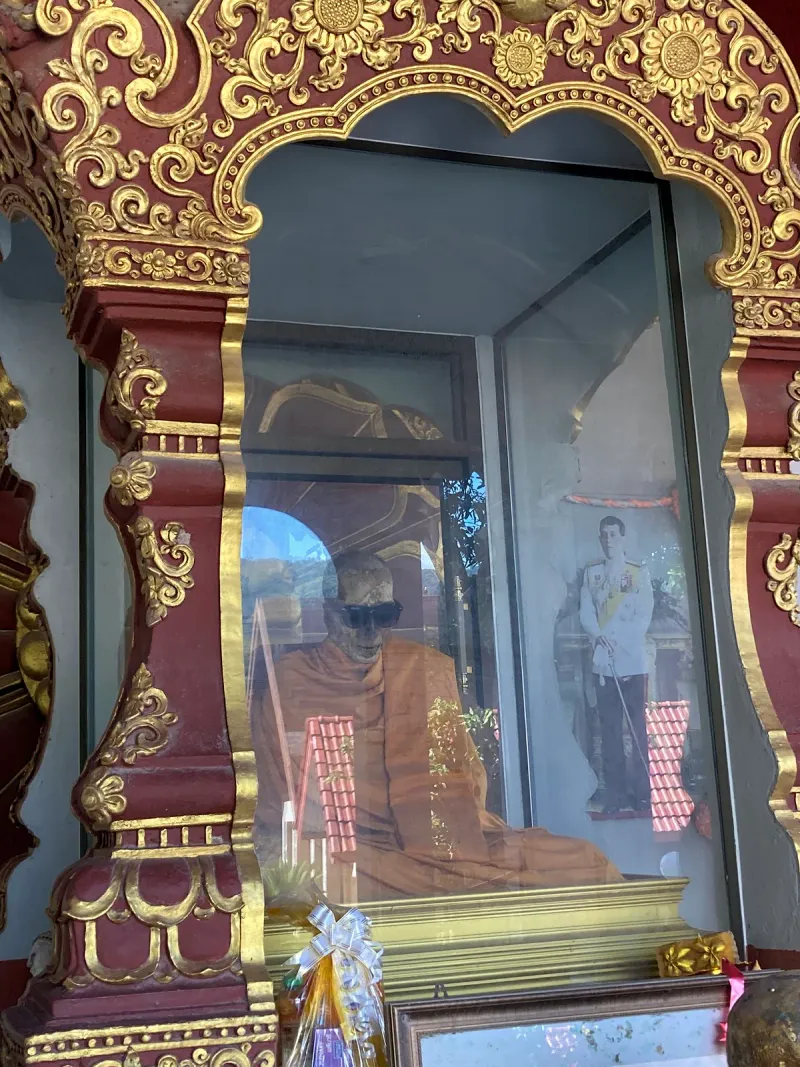
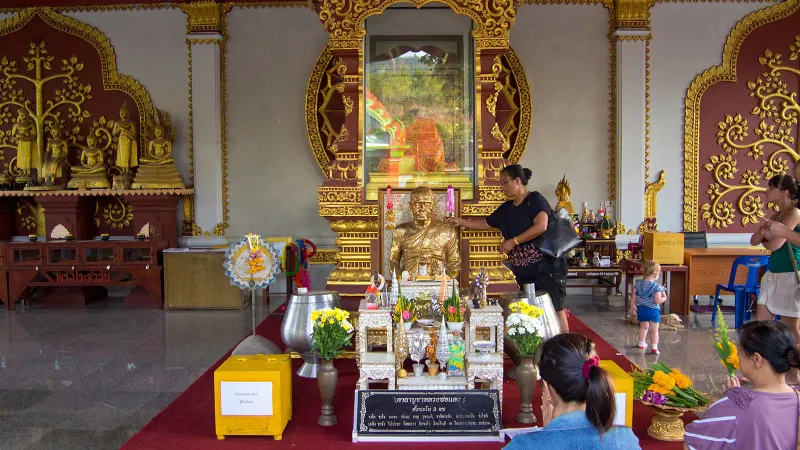
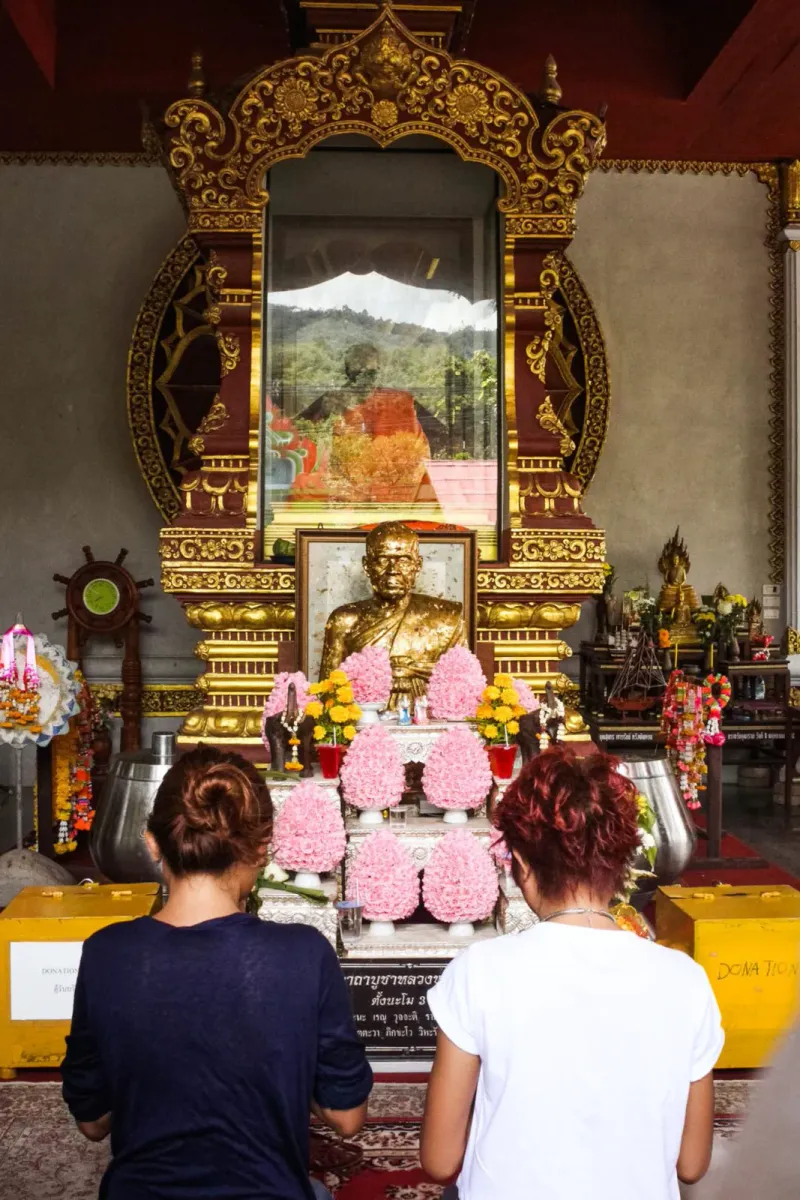
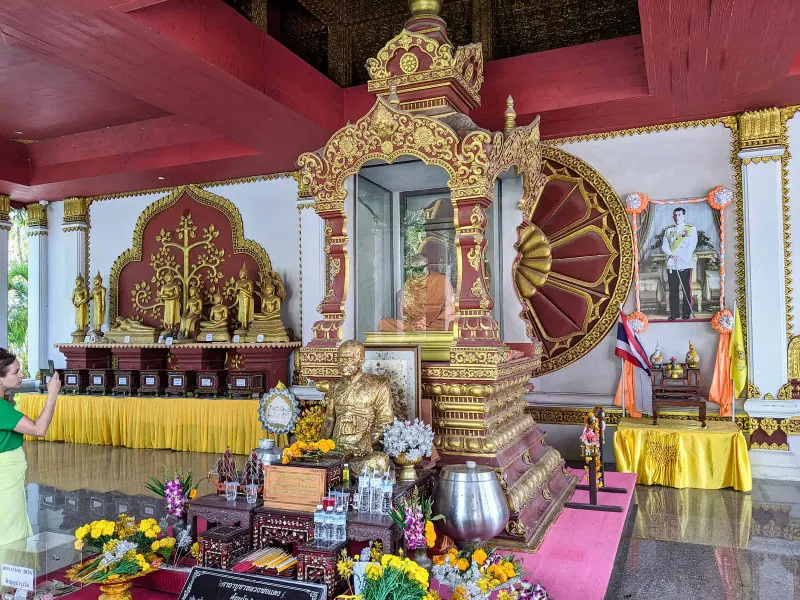
Wat Khunaram (วัดคุณาราม) is the temple on Koh Samui that holds the preserved body of Luang Pho Daeng, a monk who died in 1973 while meditating. He sits upright in a glass case, wearing sunglasses. Entry is free, the temple is open daily 8:00-17:00, and it stands on the Route 4169 ring road in the south-east, about 6 km from Lamai.
For many Western visitors the sight is jarring at first. For Thai Buddhists, Luang Pho Daeng is a figure of deep respect, and the display is a physical reminder of impermanence, one of the core Buddhist teachings.
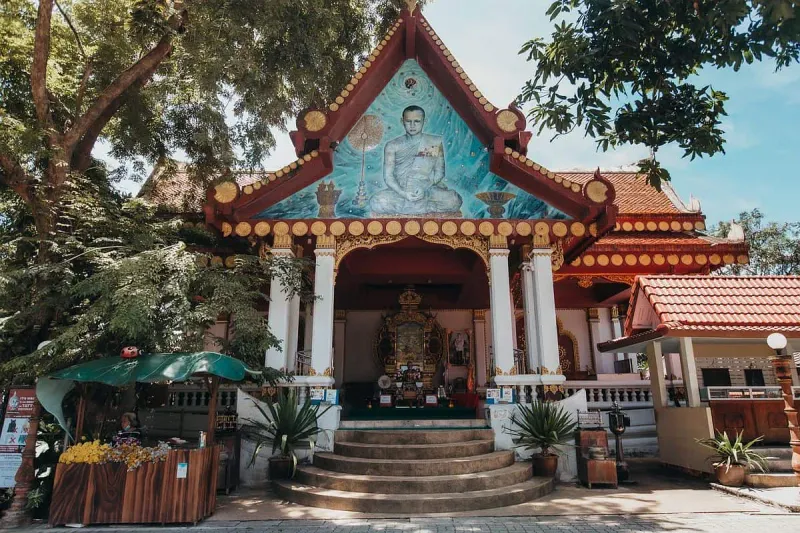
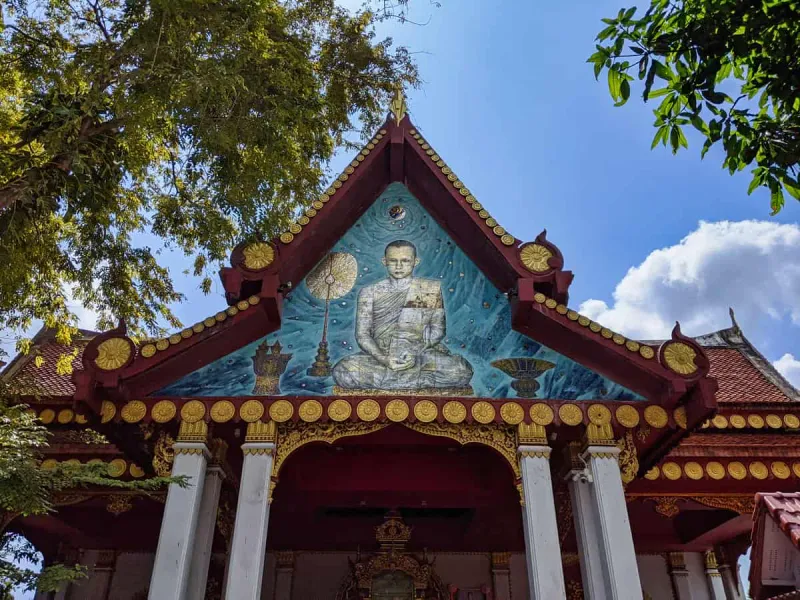
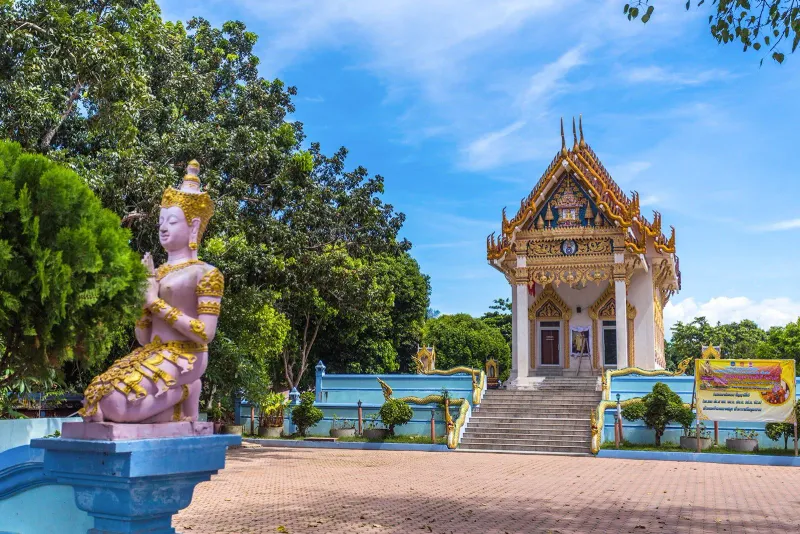
The ordination hall facade, with the monk's mosaic portrait above the door.
Where Is the Mummified Monk on Koh Samui?
The mummified monk is at Wat Khunaram, directly on Route 4169, the ring road that circles Koh Samui. The temple lies between the Na Muang waterfalls and Hua Thanon in the south-east, about 6 km west of Lamai and roughly 13-15 km south-east of Nathon.
By scooter or car: Follow the ring road from Lamai towards Na Muang. The temple is signed in Thai and English, and the gate sits right on the road.
By songthaew: Songthaews running the southern ring road pass the entrance. Tell the driver “Wat Khunaram” or “mummy monk” and say where to stop.
Parking: Free parking is available inside the temple grounds.
On a tour: Island tours often bundle it with the Guan Yu Shrine and the waterfalls, but you do not need a tour to visit.
Opening Hours and Entry Fee
Wat Khunaram is open daily from 8:00 to 17:00, as listed by most visitor sources in 2026, and entry is free. There are no tickets: listings that show a “ticket” are tour bookings that include a transfer. Small donations are welcome and go towards the upkeep of the temple and the monk’s glass case. Visitors often leave about 20 THB (~0.60 USD) in a donation box.
The Story of Luang Pho Daeng: A Life of Devotion
Luang Pho Daeng was born on Koh Samui in 1894. For the first fifty years of his life he followed a secular path: he married, raised six children, and was a respected member of the local community, though spiritual matters always interested him.
At around 50, once his children were grown, he became a monk. He was known as a master of meditation, practised insight and calm-abiding meditation, and served as abbot of Wat Khunaram, where he was known for his wisdom and simple way of life.
The Mummified Monk: A Meditative Legacy
Luang Pho Daeng reportedly foretold his own death at about 79. He asked that his body be kept on view at the temple as a reminder of how fleeting human life is, rather than be cremated.
In 1973, while seated in the lotus position in meditation, he passed away. His body did not decay in the way people expected, and today it stays in that same seated posture in a glass casket.
Is the Mummified Monk Real?
Yes, the body is real, not wax. It is a rare case of a body that stayed preserved without embalming chemicals, and visitors can see it directly in the glass case. How that happened is explained in different ways. Devotees say it reflects his advanced meditative state. Sceptics point to his very low food intake, the dry state of the body at death and the airy temple hall. Wikipedia adds that he is said to have intended to mummify himself but did not fully manage it, and that others preserved the body after death, so treat any single explanation as a belief rather than a proven fact.
Why Does the Monk Wear Sunglasses?
The Ray-Ban style sunglasses were added by the temple caretakers to cover the sunken eye sockets, so the sight is less frightening for children and for visitors who are not expecting it. The rest of the body is displayed as it was.
Understanding Impermanence: Anicca
The display of Luang Pho Daeng’s body is not a spectacle of the macabre; it is a lesson in Anicca, the Buddhist concept of impermanence. The teaching states that everything in the physical world is in constant change and decay.
By looking at the monk, followers are encouraged to reflect on the transient nature of their own bodies and the importance of focusing on spiritual growth rather than material attachment. It is a stark, honest confrontation with death that is meant to lead to a more meaningful life.
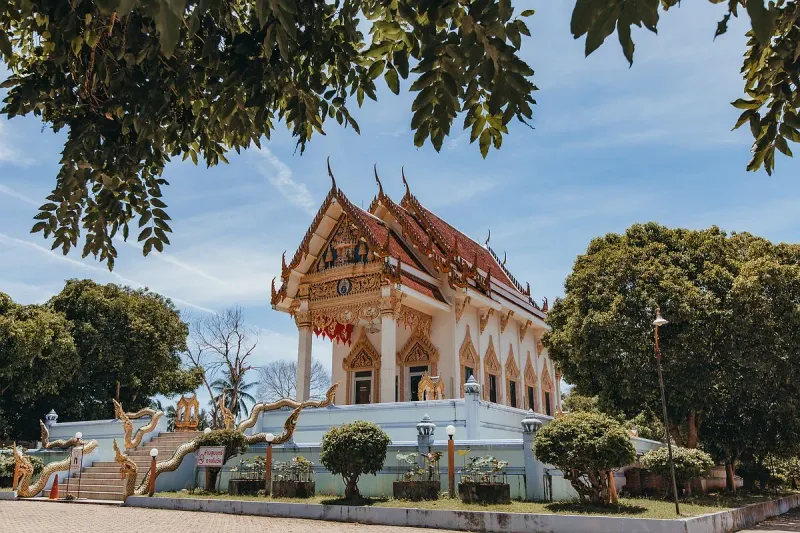
The ordination hall, with its naga-flanked staircase and tiered red roof.
Temple Features: Shrines and Fortunes
Beyond the mummified monk, Wat Khunaram is a traditional southern Thai temple.
Ornate Carvings: The main hall has gold-leaf carvings and red accents typical of Samui’s wats.
Fortune Telling (Siam Si): Bamboo containers hold numbered sticks. Shake one until a stick falls out and you can collect a printed fortune, available in Thai and English, for that number.
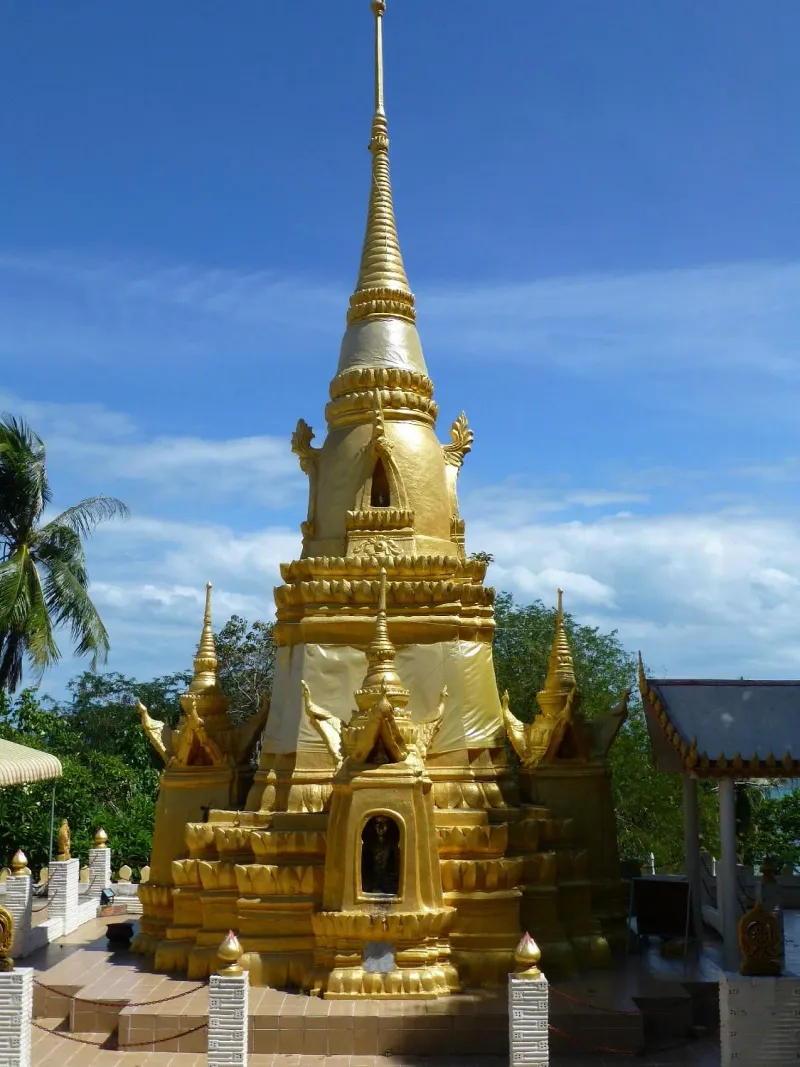
Buddha Images: The grounds hold several Buddha statues in different postures, each tied to a day of the week or an event in the Buddha’s life.
Memorial hall: Inside, visitors pray before a golden bust of the monk.
Activities: Merit-Making and Reflection
A visit to Wat Khunaram is usually quiet and contemplative.
Make Merit: You can buy lotus flowers, candles and incense at the entrance to offer at the altar.
Receive a Blessing: If a monk is available, you can sit before him for a water blessing and a white string wristlet (Sai Sin). Leave a donation.
Silent Reflection: Many visitors find the presence of Luang Pho Daeng leads to a moment of silence.
Visiting Etiquette and Photos
Wat Khunaram is a working place of worship, so follow the rules visitors are asked to keep.
Dress code: Cover shoulders and knees. Avoid beachwear and sleeveless tops. See temple etiquette on Koh Samui for the full list.
Shoes: Take them off before the hall where the monk is enshrined.
Quiet: Keep your voice low and your phone on silent.
Feet: Never point your feet at the monk or any Buddha image.
Women and monks: Women should not touch a monk or hand him anything directly; place an offering on the cloth or pass it through a man.
Photos: Photography is generally tolerated, but avoid flash near the monk, and if in doubt ask a temple caretaker. Photos of the exterior, the hall and the grounds are shown in the gallery below.
Where to Eat: Southern Samui Flavors
The temple sits on the ring road between the island’s main waterfalls, so food is close.
Visit the temple first, while it is quiet and cooler, and leave the afternoon for a swim. Na Muang and Wang Sao Thong run strongest from September to January; in the dry months the pools shrink. Wear modest clothing at the temple, carry swimwear in a bag for the falls and change at the waterfall, not in the temple grounds. For more wats, see the Koh Samui temples guide.
Best Time to Visit
The temple is open daily from 8:00 AM to 5:00 PM.
Time
Experience
Rating
8:00 AM - 10:00 AM
Quietest time; cooler temperatures; best for photos.
★★★★★
11:00 AM - 2:00 PM
Can be very hot and busy with large tour groups.
★★★
3:30 PM - 5:00 PM
Soft afternoon light; local devotees arrive for prayers.
★★★★
Who Is Wat Khunaram Best For?
Traveler Type
Rating
Why?
Cultural Seekers
★★★★★
A uniquely Thai spiritual experience found nowhere else.
Spiritual Travelers
★★★★★
A physical reminder of the core Buddhist teaching of impermanence.
History Buffs
★★★★
Learn the life story of one of Samui’s most famous residents.
Curiosity Seekers
★★★★
The “monk in sunglasses” is one of the island’s most memorable sights.
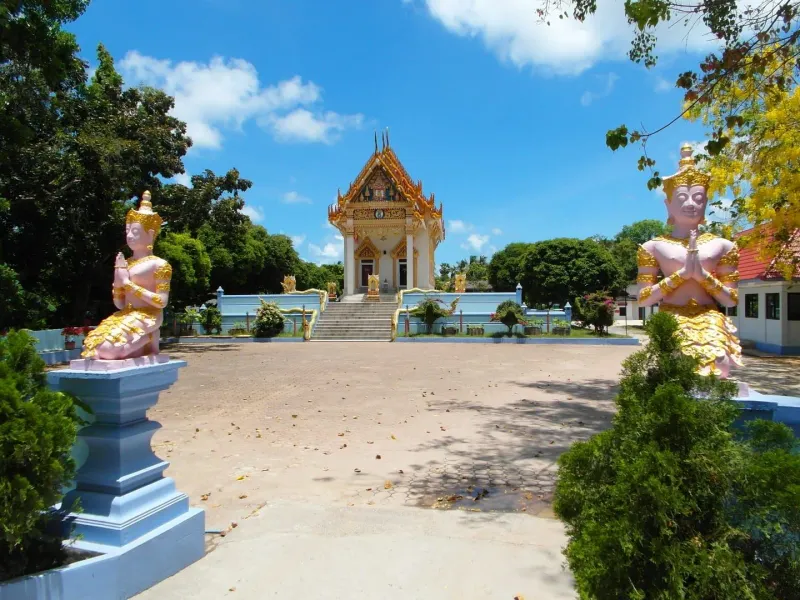
Wat Khunaram: a sanctuary of spiritual reflection on Koh Samui, and its wider temple grounds.
FAQ
Who was the mummified monk?
The monk was Luang Pho Daeng, a respected former abbot of Wat Khunaram. Born on Koh Samui in 1894, he became a monk at about 50 after raising six children, was known as a meditation master, and died in 1973 while sitting in meditation. His body has been displayed at the temple ever since.
Is the mummified monk in Koh Samui real?
Yes. The body at Wat Khunaram is the real preserved body of Luang Pho Daeng, not a wax figure. Devotees credit his meditative state, while sceptics point to dryness, diet and airflow. How it was preserved is explained differently by different sources, so treat explanations as beliefs.
Why does the mummified monk wear sunglasses?
Temple caretakers added the sunglasses to cover the sunken eye sockets, because the body’s eyes had decayed. It makes the sight less frightening for children and first-time visitors, and it is a deliberate act of respect rather than a joke.
Is there an entrance fee or ticket for Wat Khunaram?
No. Entry to Wat Khunaram is free and there are no tickets at the gate. Small donations are welcome to help with the upkeep of the temple. Online “tickets” are usually tour bookings that include transport and other stops, not temple admission.
What are the opening hours of Wat Khunaram?
Wat Khunaram is open daily from about 8:00 to 17:00, according to most visitor sources in 2026. The quietest time is 8:00-10:00. Hours can shift on Buddhist holy days or during ceremonies, so confirm locally if you are arriving near opening or closing.
Is it scary for children?
Most children are curious rather than afraid. The sunglasses and the calm atmosphere help make it a respectful visit, but parents of very young or sensitive children may want to prepare them before entering the hall.
How long should I spend at the temple?
Most visitors spend 20-30 minutes: enough to see the monk, walk through the shrines, and perhaps receive a blessing or try the fortune sticks. Add 10-15 minutes if you plan to light incense or sit for a blessing.
Travel photographer and island explorer. Mike has spent years documenting Southeast Asia's hidden gems, from secluded beaches to jungle waterfalls.
When to go
The temple calendar
Which day to come
Every day of the week carries its own Buddha posture, and this temple's own festival dates are set out beside it, or the general holy-day rule where it keeps none of its own.
SundayStanding in contemplation
MondayCalming the ocean
TuesdayReclining
WednesdayHolding the alms bowl
Wednesday nightRetreat into the forest
ThursdaySeated in meditation
FridayHands crossed at the chestToday
SaturdayShielded by the naga
Festivals here
No festival of its own
Wan Phra
Wan Phra, the Buddhist holy day, falls on the new moon, the first-quarter moon, the full moon and the last-quarter moon, roughly every seven to eight days, never on a fixed weekday.
Only the etiquette that applies at this temple, drawn from the island's general rules and narrowed to match its own shoes, dress, fee and quiet requirements.
Cover shoulders and knees
Shoulders and knees stay covered inside every temple, no matter how hot the day, for women and men alike.
Take off your shoes
Shoes and sandals come off before stepping into any hall with a Buddha image, no exceptions.
Mind your feet
Never point your feet at a Buddha image or a monk; tuck them behind you if you sit on the floor.
Nothing above the Buddha
Never touch a monk's head, and don't reach for anything above a seated Buddha image either.
Women and monks
Women never touch a monk or hand him anything directly; use a cloth or set the item down instead.
Ask before photographing
Ask before photographing a monk up close, and skip the flash and the selfie stick inside a prayer hall.
Keep your voice down
Keep your voice low and your phone silent inside any hall where people are praying or meditating.
Nearby Places
Just past the gate
What's within reach
The nearest beach, temple, waterfall and trail from this gate, each with its real distance and true direction, for whatever comes after this stop.