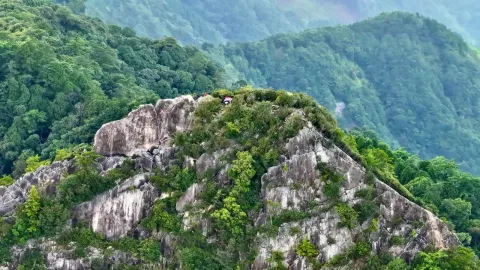
Best hikes on Koh Samui: 24 trails ranked by difficulty, with flow months for 11 waterfalls, the Khao Pom hike, viewpoints and when to go.
Overview
The best hikes on Koh Samui are the Samui 360 Viewpoint Trail for views, the Khao Pom hike for a challenge and the Wang Sao Thong Trail for an easy walk. The best all-round waterfall is Na Muang Waterfalls: an easy 100-meter walk to a swimming pool plus an 80-meter jungle scramble to the island’s tallest cascade. The best easy hike, the Wang Sao Thong Trail, is an 8-10 minute forest walk to a quiet two-tier falls. The best viewpoint hike, the Samui 360 Viewpoint Trail, is a 4.3 km round trip to the island’s single best 360-degree panorama.
Koh Samui’s interior hides 11 named waterfalls and more than two dozen signed hiking trails across its central mountains, from flat five-minute strolls to a guide-required 8 km summit push. Every waterfall on the island runs on rainfall, not a fixed source, so the same cascade can be a thundering curtain in November and a trickle over dry rock in April. This guide tables the monthly flow pattern for all 11 waterfalls and the core stats (distance, elevation gain, time, difficulty, and whether there’s a viewpoint) for 24 hiking trails, then breaks down the best picks by category and season.
Key takeaways
- Waterfalls run strongest October-January, right after the Oct-Nov monsoon peak; most run low or dry from March to May.
- Na Muang Waterfalls is the only fall with both an easy swimming pool and a genuine 80m jungle trek in one visit.
- The easiest hikes (Wang Sao Thong Trail, Lad Koh Viewpoint) take under 20 minutes each way; the hardest (Khao Pom Summit Trek, Nathon Mountain Ridge Trek) need 4+ hours and real fitness.
- Guides are effectively required for Khao Pom (no marked trail) and recommended for the Sleeping Buddha Trail.
- Leeches, slippery rock, and sudden downpours are the three real hazards. See Safety & Gear before you go.
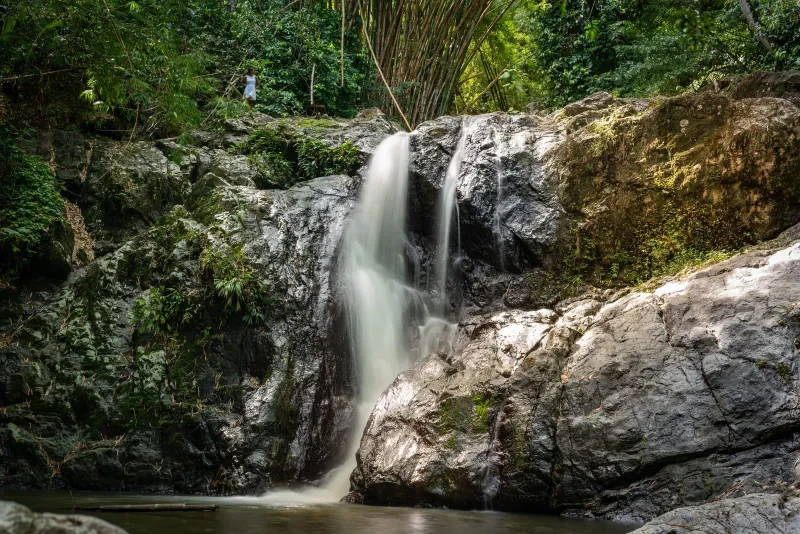
Waterfall Flow by Month
Koh Samui’s waterfalls are rain-fed, so flow strength swings hard between the wet and dry halves of the year: the table below reads left to right from January through December using each waterfall’s own seasonal notes (linked pages below) cross-checked against the island’s general rainfall pattern. Treat it as a planning guide, not a gauge reading: a single storm can fill a “dry” month’s pools overnight, and a dry spell can thin a “strong” month early.
Legend: S = Strong flow (best swimming/photos) · G = Good (swimmable, flowing) · L = Low (thin flow, still visible) · D = Dry (trickle or dry rock)
| Waterfall | Jan | Feb | Mar | Apr | May | Jun | Jul | Aug | Sep | Oct | Nov | Dec |
|---|---|---|---|---|---|---|---|---|---|---|---|---|
| Na Muang Waterfalls | S | L | L | D | D | L | L | G | G | S | S | S |
| Hin Lad Waterfall | L | D | D | L | G | G | G | S | S | S | S | L |
| Tarnim Magic Garden | L | L | D | D | D | G | G | G | G | S | S | L |
| Wang Sao Thong Waterfall | G | G | D | D | D | D | D | D | S | S | S | S |
| Khao Yai Waterfall | G | G | L | D | D | D | L | L | G | S | S | S |
| Tartain Waterfall | G | G | L | D | D | D | L | L | G | S | S | S |
| Lat Wanon Waterfall | S | G | G | D | D | D | D | D | L | G | S | S |
| Zong Raue Waterfall | S | L | L | L | G | G | G | G | G | S | S | S |
| Tan Rua Waterfall | S | S | L | D | D | L | G | G | G | G | S | S |
| Khun Si Waterfall | G | G | G | L | L | L | L | G | G | S | S | S |
| Sivatara Waterfall | G | G | L | L | L | G | G | G | G | G | G | G |
How to read it: Sivatara Waterfall is the exception: it sits inside a managed adventure park with a fish spa and topped-up pools, so it stays “Good” almost year-round instead of swinging between Strong and Dry like the others. Everything else on the list is genuinely seasonal, which is why the same trail can feel completely different depending on when you hike it.
Trail Comparison Table
Koh Samui has 24 signed or well-documented hiking trails, ranging from a 10-minute roadside stroll to an 8 km jungle expedition with no marked path. Distance and elevation figures below come from each trail’s dedicated guide (linked); a dash means the source page reports time rather than exact distance or elevation. Check the linked guide for the fuller picture.
| Trail | Distance | Elevation Gain | Time | Difficulty | Viewpoint |
|---|---|---|---|---|---|
| Na Muang Waterfalls Trail | 3.9 km RT | 220 m | 5-40 min | ★★★ (mixed easy/hard) | No |
| Hin Lad Waterfall Trail | 2.6 km RT | 130 m | 30-40 min ow | ★★★ | No |
| Khao Pom Summit Trek | ~8 km RT | ~500 m | 4-6 h | ★★★★★ | Yes |
| Lardwanorn Waterfall Loop | ~2.5 km loop | - | 1-1.5 h | ★★ | Yes |
| Khun Si Waterfall Trail | ~0.5 km | - | 10-15 min (1-2 h total) | ★★★ | Yes (nearby) |
| Tartain Waterfall Trek | ~1.2 km RT | - | 30 min asc (2 h total) | ★★★★ | No |
| Tan Rua Trail | ~0.5 km RT or 9.3 km loop | - | 45 min or 3.5 h | ★★ (short) / ★★★★★ (loop) | No |
| Maenam to Magic Garden Traverse | ~10 km one-way | - | 3-4 h | ★★★★★ | Yes |
| Khao Nui Loop | 8.7 km loop | - | 2-3.5 h | ★★★ | Partial |
| Khao Phra Trail | ~10 km RT | - | 3.5-4 h | ★★★★ | No |
| Lad Koh Viewpoint | short RT | ~10 m | 20-40 min | ★ | Yes |
| Wang Sao Thong Trail | ~2 km RT | - | 8-10 min ow | ★ | No |
| Hog Trail | 5.2 km RT | 314 m | ~2 h | ★★ | No |
| Sleeping Buddha Trail | - | - | 90 min ow (3 h RT) | ★★★ | No |
| Samui 360 Viewpoint Trail | 4.3 km RT | 426 m | 2-2.5 h | ★★★ | Yes |
| Grand Viewpoint Traverse | 10.2 km | 586 m | ~4 h | ★★★ | Yes |
| Monkey Trail | ~8 km (day loop) | - | 3-4 h | ★★★★ | Yes |
| Ang Thong Emerald Lake | ~400-500 steps | - | 30-45 min | ★★★ | Yes |
| Coral Cove to Silver Beach | 1.2-1.6 km RT | flat | 20-30 min ow | ★★ | No |
| Overlap Stone Viewpoint | ~0.5 km ow | - | 15-20 min ow | ★★ | Yes |
| Nathon Mountain Ridge Trek | 8-13.5 km | 200-450 m | 2-4 h | ★★★★★ | Yes |
| Secret Buddha Garden Trail | - | 300 m to ~400 m | 1-2 h | ★★★ | No |
| Ang Thong Wua Talab Viewpoint | ~500 steps | - | 30-45 min | ★★★★ | Yes |
| Lamai Viewpoint | <1 km RT | - | 10-15 min | ★★★ | Yes |
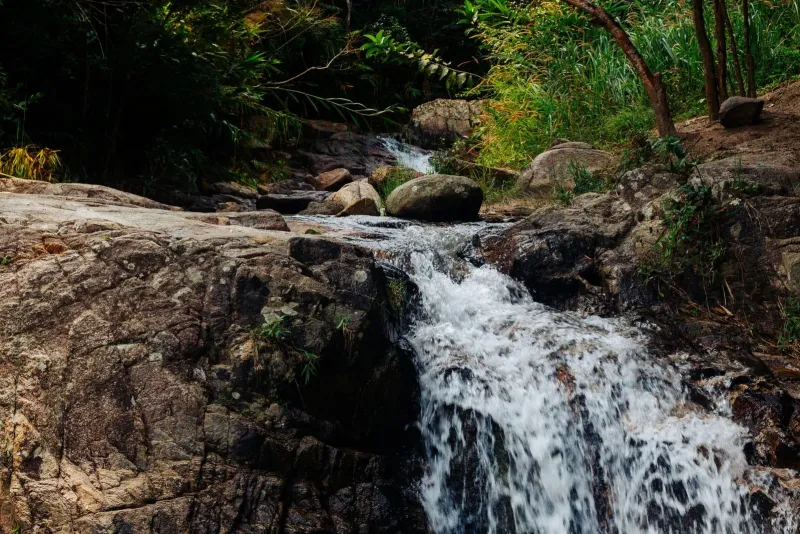
Best Waterfalls on Koh Samui
Koh Samui’s best waterfalls span easy family swimming holes to remote, family-run jungle sites reached by rope and bamboo walking stick. For the quieter cascades most visitors skip (Zong Raue, Wang Sao Thong, Tartain and Khun Si), see the hidden gems guide.
1. Na Muang Waterfalls
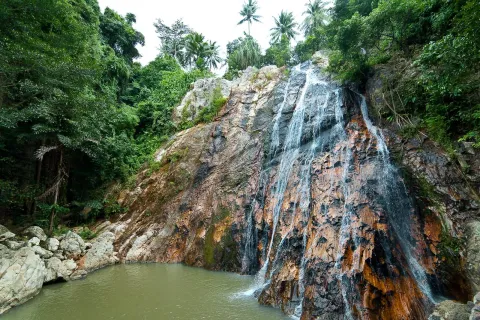
Na Muang Waterfalls is the island’s most complete waterfall destination: Na Muang 1 is an 18-meter drop into a swimming pool 100 meters from the car park, and Na Muang 2 is Samui’s tallest fall at 80 meters, reached by a 30-40 minute rope-assisted scramble. Free admission, 60 THB (~1.50 USD) car parking, strongest flow December-January. Best for: anyone who wants both an easy dip and a real hike in one stop.
2. Hin Lad Waterfall
Hin Lad Waterfall is Samui’s second-largest fall at 30 meters, reached by a 1.2 km, 20-40 minute trail that starts at a working Buddhist temple, Wat Namtok Hin Lat, where resident monks run meditation workshops. Free, 3 km from Nathon, best flow May-November. Best for: travelers who want jungle, waterfall, and temple culture in a single free outing.
3. Tan Rua Waterfall
Known locally as the “Secret Falls,” Tan Rua Waterfall is Samui’s third-largest by volume, tucked into Maenam Soi 5 with a treehouse café at the trailhead. The short walk is 5-10 minutes from parking; strongest flow December-February. Best for: north-coast visitors who want a quiet fall with a coffee stop built in.
4. Khun Si Waterfall
Khun Si Waterfall sits above Bophut in durian-plantation country, with a rare traversable cave behind the main water curtain and the Khun Si Viewpoint a short walk beyond. Entry is effectively free (parking at nearby bars ~50 THB); best flow October-December. Best for: hikers who want a waterfall, a cave, and a Koh Phangan viewpoint in one loop. See the linked Grand Viewpoint Traverse for the extended version.
5. Sivatara Waterfall
Sivatara Waterfall anchors a privately managed adventure park in Lamai that also includes the heart-shaped Valentine Stone, a fish spa, and a canopy zipline. Entry runs 100-300 THB (~3-8.50 USD) depending on access level, and flow stays moderate almost year-round thanks to managed pools. Best for: families who want a half-day of activities rather than a pure nature hike.
6. Tartain Waterfall
Tartain Waterfall is the island’s most remote fall, on private land in the Lipa Noi hills with nine distinct tiers and an entry fee (100-150 THB, ~3-4.50 USD) that includes a bottle of water and a bamboo walking stick. Best flow October-December, though the wettest months also make the 1.5 km trail its most slippery. Best for: adventurous hikers chasing the least-crowded fall on Samui. Pair it with the linked Tartain Waterfall Trek for the full rope-climb write-up.
The remaining five (Tarnim Magic Garden, Wang Sao Thong Waterfall, Khao Yai Waterfall, Lat Wanon Waterfall, and Zong Raue Waterfall) are all quieter, free, and worth a stop if you’re already in their part of the island; see the flow table above for when each runs strongest.
Best Hikes by Difficulty
Trail difficulty on Koh Samui depends less on distance and more on terrain: a short trail with a steep, root-covered climb can feel harder than a long, flat one.
Easy
- Wang Sao Thong Trail: an 8-10 minute, mostly flat walk near Hua Thanon to a quiet two-tier fall almost nobody visits.
- Lad Koh Viewpoint: a 20-40 minute paved round trip on Route 4169 to a railed platform over Chaweng Bay; needs almost no fitness.
- Coral Cove to Silver Beach: a flat, 20-30 minute boulder-hop along the shoreline between two east-coast coves, best at low-to-mid tide.
Moderate
- Hin Lad Waterfall Trail: 2.6 km, 130 m of gain, temple-to-waterfall riverside path with roots and river crossings.
- Samui 360 Viewpoint Trail: 4.3 km, 426 m of gain, mixed paved-and-dirt climb to the island’s best panorama; no guide needed.
- Khun Si Waterfall Trail: short but steep and slippery descent through durian plantations to tiered swimming pools.
Hard
- Khao Pom Summit Trek: ~8 km, 4-6 hours to Samui’s 635 m high point through unmarked primary rainforest; a local guide (2,000-3,000 THB, ~60-90 USD) is essentially required.
- Maenam to Magic Garden Traverse: ~10 km point-to-point across the island’s mountain spine, 3-4 hours, needs a pickup at the far end.
- Nathon Mountain Ridge Trek: 8-13.5 km with 200-450 m of elevation gain along an exposed ridge; locals rank it Samui’s toughest maintained route.
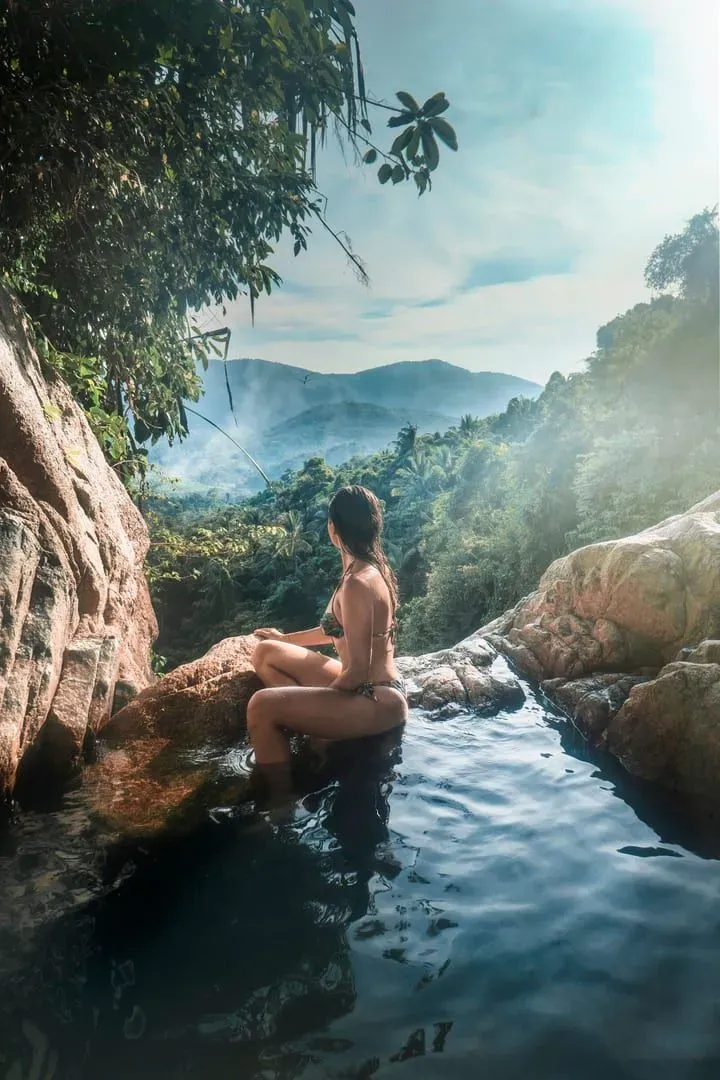
Best Viewpoint Hikes
Koh Samui’s viewpoint hikes range from a 10-minute paved walk to a boat-only island climb, but they share one thing: a payoff view you can’t get from the ring road.
- Samui 360 Viewpoint Trail: the single best 360-degree panorama on the island, from the summit ridge of Khao Pom; 2-2.5 hours round trip.
- Lad Koh Viewpoint: the easiest sea view on Samui, a 20-40 minute stroll to a railed platform over Chaweng Bay, best at sunrise.
- Overlap Stone Viewpoint: a 15-20 minute climb above Lamai to a balanced granite boulder and a 150 m panorama over Lamai Bay.
- Grand Viewpoint Traverse: links Khun Si Waterfall to two-plus highland viewpoints and a mountaintop restaurant over a ~10.2 km, 4-hour route.
- Ang Thong Wua Talab Viewpoint: the only viewpoint on this list you reach by boat, not scooter: a 30-45 minute limestone-step climb over all 42 islands of Ang Thong National Marine Park.
When to Go: Season Logic
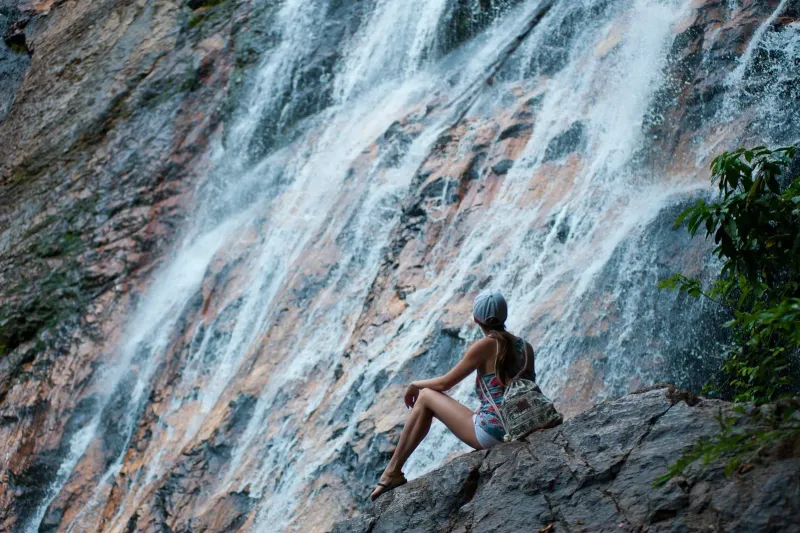
The short answer: October through January for the strongest waterfalls, December through February for the driest, safest trail conditions, and those two windows only fully overlap in December and January.
Koh Samui’s rainfall is heavily back-loaded, according to Thai Meteorological Department 30-year averages: November averages roughly 526 mm, October about 266 mm, while February averages just 33 mm. That’s why every waterfall on the flow table above peaks in the October-to-January window and thins out from March to May, when several falls (Wang Sao Thong, Khao Yai, Tartain) reduce to a trickle or dry rock entirely.
For hiking specifically, the calculus flips slightly: December-April brings the driest, least slippery trail surfaces, which is why guides for Khao Pom and the Nathon Mountain Ridge Trek both point to this window. Trekking the same routes in September-November peak monsoon means muddy, root-slick paths even though the waterfalls themselves look their best. December and January thread the needle (strong water, manageable trails), which is why both waterfall pages and trail pages converge on it as the island’s best all-round month.
If your trip falls outside that window, plan around it: March-May for cooler mornings and open trails but drier falls, or hike higher-elevation, better-shaded trails like Khao Phra or Khao Nui Loop during the hottest stretch. See the site’s Best Time to Visit guide for month-by-month weather beyond waterfalls and trails.
Safety & Gear
Leeches are the most common jungle-trail encounter on Samui, especially on wet-season hikes through Khao Pom, Tartain, and the Sleeping Buddha Trail’s undergrowth. They aren’t dangerous (no venom, no disease), but a chemical repellent with 15-30% DEET, long socks tucked into closed shoes, and light-colored close-fitting trousers cut bites down significantly.
Slippery rock and mud cause more real injuries than leeches. Trail conditions worsen fast after rain on routes like Khun Si Waterfall Trail (steep red clay) and the Na Muang Waterfalls Trail’s rope-assisted Na Muang 2 section: grippy, closed-toe shoes are non-negotiable, not sandals.
Guides are worth the money on two routes specifically: Khao Pom Summit Trek has no marked path through primary rainforest, and the Sleeping Buddha Trail pushes 90 minutes past the last marked point at the Secret Buddha Garden. Everywhere else on this list is signed or well-tracked enough for an independent hiker with a downloaded GPS route.
Water and timing matter more than gear in Samui’s heat and humidity. Carry at least 1 liter per hour of hiking, start before 9 AM on longer routes (the Khao Phra Trail and Monkey Trail both run 3+ hours), and check the sky before committing to routes with river crossings, since jungle streams can rise quickly during a downpour. See our Koh Samui packing list for full trail-day gear, and the is Koh Samui safe guide for broader island safety beyond the trails.
FAQ
What is the best waterfall on Koh Samui?
Na Muang Waterfalls is the best all-round pick: Na Muang 1 offers an easy 100-meter walk to a swimming pool, and Na Muang 2 is the island’s tallest fall at 80 meters, reached by a 30-40 minute rope-assisted trek. Flow peaks December-January. For a quieter alternative with a temple, see Hin Lad Waterfall.
When do Koh Samui’s waterfalls have the strongest flow?
October through January, right after the October-November monsoon peak (TMD data puts November rainfall at roughly 526 mm). Most waterfalls (including Wang Sao Thong, Khao Yai, and Tartain) reduce to a trickle or dry rock between March and May.
Do I need a guide for hiking on Koh Samui?
Not for most trails: routes like Samui 360 Viewpoint Trail and Hin Lad Waterfall Trail are well-marked. A guide is effectively required for Khao Pom Summit Trek, which has no marked path, and recommended for the Sleeping Buddha Trail.
Are there leeches on Koh Samui’s hiking trails?
Yes, especially during the wet season on jungle routes like Khao Pom and Tartain Waterfall Trek. Leeches carry no venom or disease, and long socks tucked into closed shoes plus a DEET-based repellent (15-30%) prevent nearly all bites.
What is the easiest hike on Koh Samui?
The Wang Sao Thong Trail (an 8-10 minute, mostly flat forest walk near Hua Thanon) and the Lad Koh Viewpoint, a 20-40 minute paved round trip to a Chaweng Bay panorama, are the two lowest-effort options on the island.
What is the hardest hike on Koh Samui?
The Khao Pom Summit Trek: an ~8 km, 4-6 hour climb to the island’s 635-meter high point through unmarked primary rainforest with a required local guide. The Nathon Mountain Ridge Trek is a close second at 8-13.5 km with 200-450 m of gain along an exposed ridge.
Which Koh Samui waterfalls need a hike?
Most need some walking. Na Muang 2 is a 30-40 minute rope-assisted scramble, Hin Lad is a 1.2 km, 20-40 minute trail, and Tartain is a roughly 1.5 km trail with rope sections. Na Muang 1 (100 meters from the car park) and Wang Sao Thong (8-10 minutes) are the easy ones.
Is there a waterfall tour on Koh Samui, or do you go alone?
Most falls are self-drive by scooter or car, and entry is free at Na Muang, Hin Lad and Khun Si (parking costs apply at some). Fees apply at Sivatara (100-300 THB, ~3-8.50 USD) and Tartain (100-150 THB, ~3-4.50 USD). A paid guide is only worth it for the Khao Pom hike, at roughly 2,000-3,000 THB (~60-90 USD).
Which is the tallest mountain waterfall on Koh Samui?
Na Muang 2 at 80 meters, reached from the same car park as Na Muang 1. Tartain has nine tiers in the Lipa Noi hills but sits on private land with an entry fee, and Hin Lad (30 meters) is the second-largest drop on the list above.
Are Koh Samui waterfalls dangerous?
The main risks are slips on wet rock and mud, fast-rising streams after heavy rain and swimming in strong flow. Skip the rope sections of Na Muang 2 and Tartain after rain, wear closed shoes and do not swim when the current is strong (October-January is the strongest flow). See Safety & Gear.
How long does the Khao Pom hike take?
The Khao Pom hike takes about 4-6 hours for roughly 8 km to Samui’s 635 m high point. The path is unmarked through primary rainforest, so a local guide is effectively required. Go December-April when trails are driest. The shorter Samui 360 Viewpoint Trail (2-2.5 hours) reaches the summit ridge view without a guide.
Published Updated Facts checked
About the author
-
 Migues Ferfumoz
Writer, Koh Samui resident since 2019
Freelance writer and Koh Samui resident since 2019. Migues covers local culture, food, and the best off-the-beaten-path destinations on the island.